Something remarkable is happening in the bullion world. For the first time in history, every major government mint is actively adding anti-counterfeiting technology to their investment-grade coins.
The Royal Mint just gave the Gold Sovereign its first security features in over 200 years. Perth Mint added micro-laser engraving to the Silver Kookaburra. And the US Mint continues to evolve the edge notch system it introduced on American Eagles in 2021.
This isn't coincidence. It's a coordinated response to a counterfeiting crisis that's been building for years—and it's reshaping how collectors should think about authentication.
Why Now?
The answer is economics. Gold crossed $5,400/oz in early 2026. Silver pushed past $50. At these prices, the profit margin on a single counterfeit coin is enormous:
- A fake 1oz Gold Eagle costs perhaps $5-10 to manufacture. It sells for $2,000+. That's a 20,000% margin.
- A fake 1oz Silver Kangaroo costs under $1 to make. It sells for $30-40.
- Scale that across thousands of units produced by Chinese CNC operations, and you're looking at an industrial-scale criminal enterprise.
The mints have been watching counterfeiting volumes grow for years. But the 2025-2026 precious metals boom made the problem impossible to ignore. Even major dealers like APMEX are now reporting counterfeit products in their supply chains.
The mints are fighting back.
The Royal Mint: Securing a 500-Year-Old Coin
The Gold Sovereign has been minted since 1489. For over five centuries, it relied on the same basic anti-counterfeiting measure: the difficulty of striking gold to the correct weight, diameter, and design quality.
That was enough—until it wasn't.
UK dealer Chards reports that "hardly a single day goes by without at least one customer bringing or sending us a fake coin". Their "Black Museum" of confiscated counterfeits is worth over £100,000. Middle Eastern workshops produce sovereign reproductions in real 21-22k gold that pass XRF testing. Chinese operations create brass-core fakes that match weight specifications.
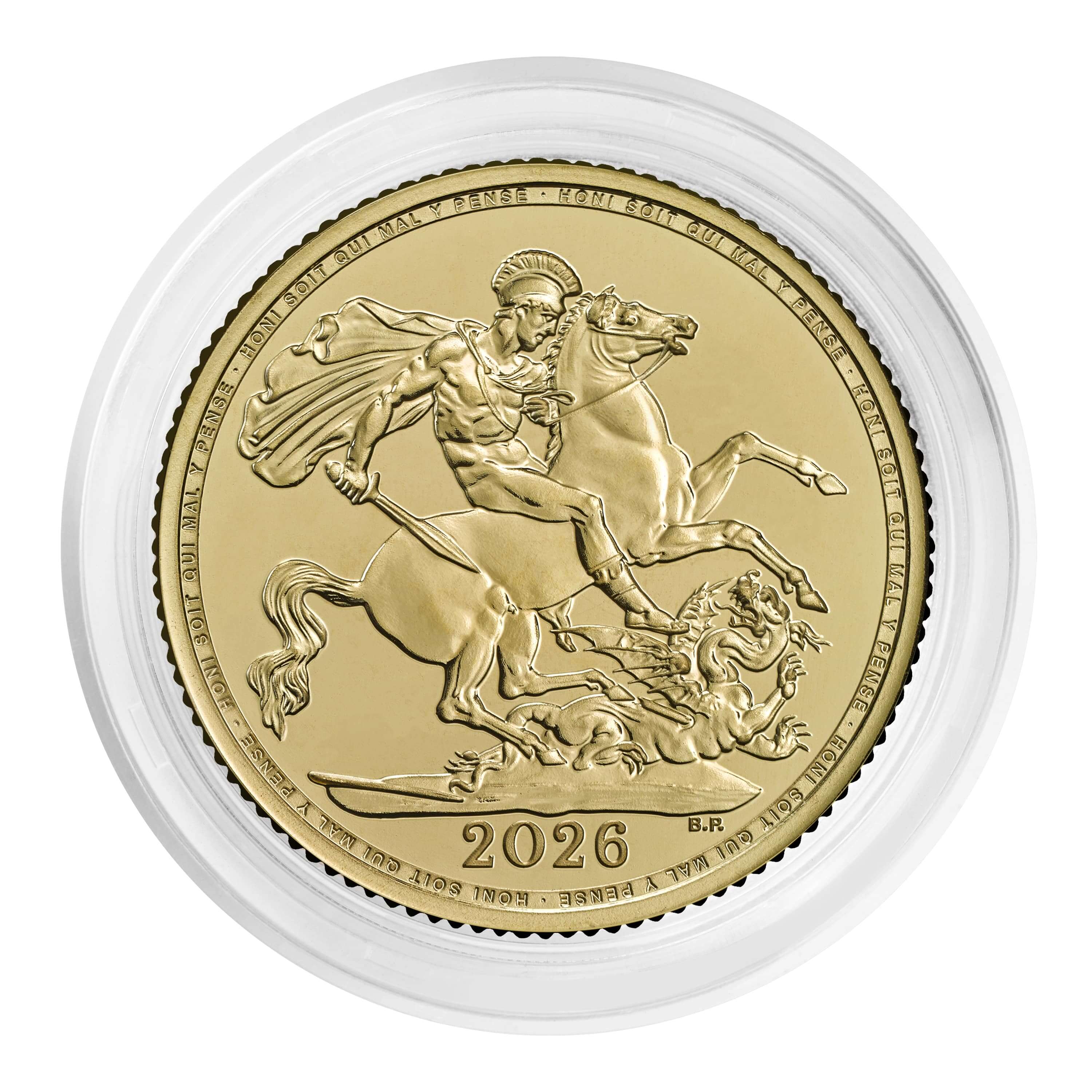
The Royal Mint's response? The 2026 Gold Bullion Sovereign is the most significant redesign in the coin's modern history:
Latent Image
A latent image beneath the King Charles III portrait alternates between three symbols when the coin is tilted: the Tudor Crown, the King's royal cypher, and the Tudor Rose — a nod to Henry VII, who introduced the Sovereign in 1489. This technology, already proven on the Britannia since 2021, requires precision laser machining that is essentially impossible to replicate outside a government mint facility.
Microtext
The reverse design is embedded with the inscription "HONI SOIT QUI MAL Y PENSE" — the motto of the Order of the Garter — engraved as microtext invisible to the naked eye. Under magnification, this text is clearly readable on genuine coins. On counterfeits, it's either absent, blurred, or incorrectly rendered.
Half-Tone Pattern
A subtle half-tone pattern on the obverse serves as an additional layer of anti-counterfeiting protection, creating visual texture that's difficult to replicate with standard die-making equipment.
Return to Yellow Gold
The 2026 Sovereign also returns to the classic yellow gold alloy after 25 years of the rosier modern alloy. While this isn't a security feature per se, it does mean that pre-2026 and post-2026 Sovereigns will look distinctly different—making it harder for counterfeiters to pass older fakes as new coins.
This is historic. A Royal Proclamation issued in May 2025 formally authorized these changes, acknowledging what collectors and dealers have known for years: the Sovereign needed modern protection.
What it means for collectors: Pre-2026 Sovereigns remain highly vulnerable to counterfeiting. The new security features only protect 2026 and later issues. If you're buying older Sovereigns, independent verification is essential.
Perth Mint: Expanding the Micro-Laser Shield
Australia's Perth Mint has been quietly building one of the most sophisticated anti-counterfeiting programs in the bullion world.
It started with the Silver Kangaroo in 2015, when Perth Mint added a micro-engraved letter "A" within the word "AUSTRALIAN" on the reverse. This tiny letter, visible only under magnification, immediately became the single most reliable way to detect counterfeit Kangaroos. FakeBullion.com's documented 2016 counterfeits lack this feature entirely.
The Lunar Series III (2020+) received similar micro-engraved security letters.
Now, in 2026, the Silver Kookaburra has joined the program. The 2026 1oz Silver Kookaburra includes a micro-laser engraved letter on the reverse—the first time this coin has received any dedicated anti-counterfeiting feature.
This matters because the Kookaburra has been counterfeited. FakeBullion.com documented a 2015 counterfeit that was high-quality enough to fool casual buyers. The fake had coarser feather detail, sharp corners on the portrait neckline, and was about 1 gram underweight—but these tells required either experience or careful measurement to catch.
Perth Mint's Security Timeline
| Coin | Security Feature Added | Type |
|---|---|---|
| Silver Kangaroo | 2015 | Micro-engraved "A" |
| Lunar Series III | 2020 | Micro-engraved letter |
| Silver Kookaburra | 2026 | Micro-laser engraved letter |
| Silver Koala | Not yet | — |
What it means for collectors: Perth Mint coins with micro-engraving are significantly harder to counterfeit. Check for the micro-engraved letter under magnification. If it's missing on a coin that should have one, be suspicious. Pre-security-feature years (Kangaroos before 2015, Kookaburras before 2026) require other verification methods.
The US Mint: The Edge Notch System
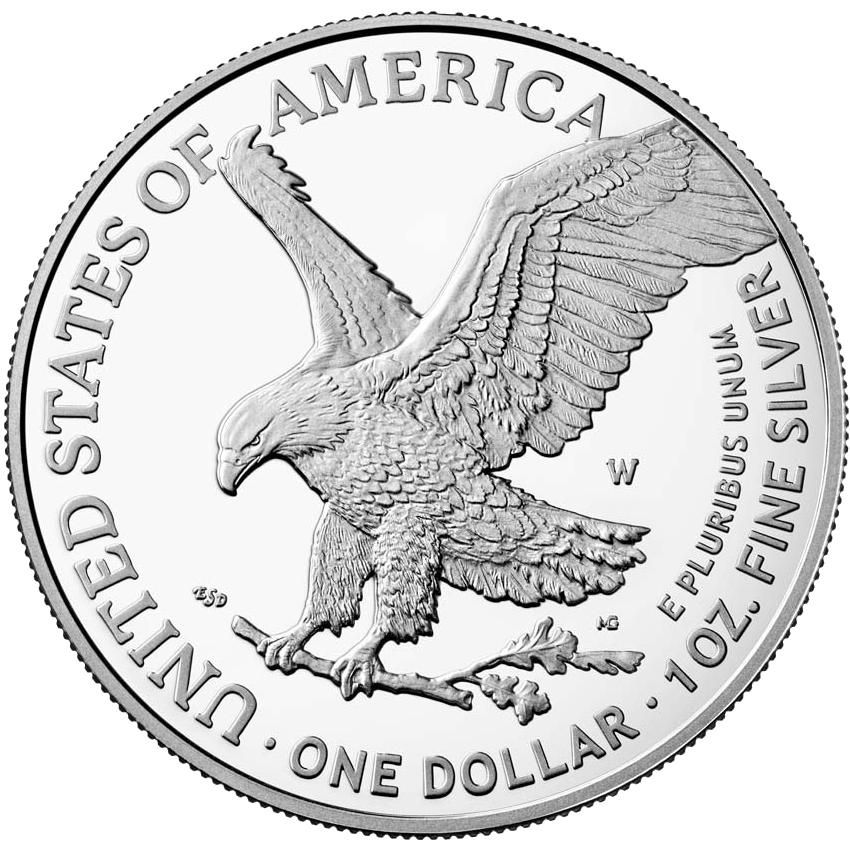
The United States Mint took a different approach when it redesigned the American Eagle in 2021. Rather than surface-level security features, they introduced a variable reeding pattern on the coin's edge.
How It Works
Every 2021+ American Eagle (both gold and silver) has a distinctive notch—a gap in the reeded edge pattern—at a specific position. When you hold the coin with the obverse facing up, this notch appears at the 6 o'clock position.
But here's where it gets clever: the notch position has moved in subsequent years. The 2022 and 2023 issues have the notch in a different location. This creates a year-specific security feature—a counterfeiter would need to replicate the correct notch position for the correct year.
Overt and Covert
The US Mint has been unusually forthcoming about having additional security features beyond the visible edge notch. A Mint official confirmed the existence of "both overt and covert" anti-counterfeiting technology. The covert features have not been publicly disclosed—which is itself a security measure.
The Mint also established a dedicated anti-counterfeiting laboratory at the Philadelphia Mint, signaling a long-term institutional commitment to fighting fakes.
What it means for collectors: Check the edge of any 2021+ American Eagle. The notch should be present and in the correct position for the year. Pre-2021 Eagles lack this feature entirely, making them more vulnerable—and more important to verify through other means.
The Royal Mint Britannia: The Gold Standard (Since 2021)
While the Sovereign just got its security upgrade, the Britannia has been the benchmark for bullion coin security since its 2021 redesign. It's worth revisiting because it demonstrates what comprehensive anti-counterfeiting looks like:
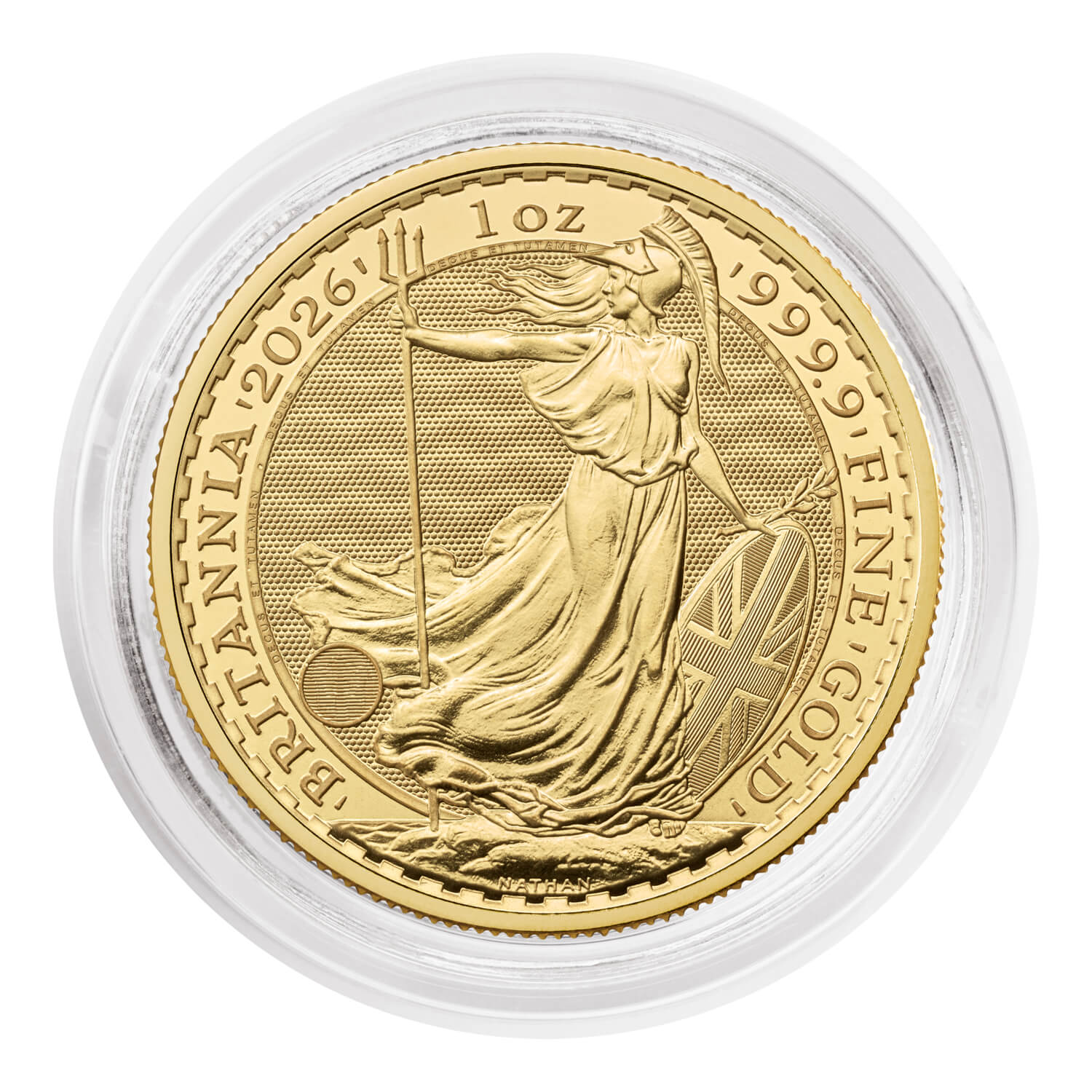
- Latent image: A padlock transforms into a trident when tilted
- Surface animation: Laser-engraved wave pattern appears to move
- Microtext: Latin phrase "DECUS ET TUTAMEN" readable under magnification
- Tincture lines: Precise background pattern on Britannia's shield
The result? In our research, we found virtually zero documented cases of successful counterfeiting of post-2021 Britannias. Reddit communities consistently confirm: "It's near impossible to counterfeit these newer Britannias currently."
The Britannia proves that comprehensive security features work. The question is whether other mints will match this level of protection.
What This Means for You
The security upgrade trend is great news for collectors—but it creates a two-tier market:
The Protected Tier
Coins with modern security features (post-2021 Britannias, 2021+ American Eagles, post-2015 Perth Mint Kangaroos, 2026+ Sovereigns and Kookaburras) are significantly harder to counterfeit. A quick check with a magnifying glass or loupe can verify the security features.
The Vulnerable Tier
Every coin minted before its security upgrade—which includes the vast majority of coins in circulation—has no built-in protection. And these are precisely the coins most likely to be counterfeited, because:
- They're older and more likely to be resold on the secondary market
- There's no quick visual check for authenticity
- Counterfeiters have had years to perfect their reproductions
This is the paradox of the security upgrade: the coins that need protection most are the ones that don't have it.
How to Verify Coins Without Security Features
For pre-security-feature coins—which includes most of what's currently in collectors' hands—you need independent verification methods:
Weight and Dimensions
A precision scale (0.01g accuracy) and digital calipers can catch crude fakes. But sophisticated counterfeits match these specifications exactly by using tungsten cores or other density-matched alloys.
Magnet Test
Silver and gold are non-magnetic. A strong neodymium magnet should slide slowly down a genuine coin (due to Lenz's law). But counterfeiters have adapted—the ACEF warned in 2024 that magnets are now unreliable for detection as fakers use non-ferromagnetic core metals.
XRF Testing
X-ray fluorescence can confirm metal composition, but it only tests the surface. A gold-plated tungsten bar will show as gold under XRF. Even Chards documented a fake Sovereign that passed a Niton XRF test.
Acoustic Testing (Ping Test)
This is where physics gives collectors an edge. Every metal has a unique resonant frequency determined by its atomic structure, density, and elasticity. When you tap a genuine silver coin, it produces a distinctive high-pitched ring that sustains for several seconds.
A tungsten-core fake—even one that matches the weight and dimensions perfectly—will have a fundamentally different acoustic signature. The speed of sound through tungsten (5,220 m/s) is dramatically different from silver (3,650 m/s), producing frequencies that are measurably wrong.
This is the one test that counterfeiters cannot defeat without using actual precious metal.
Modern smartphone apps can capture and analyze these acoustic signatures digitally, comparing them against known-authentic profiles with far greater precision than the human ear.
The Future of Bullion Security
The trend is clear: within the next few years, virtually every major bullion coin will carry some form of anti-counterfeiting technology. Perth Mint is systematically rolling it out across their range. The Royal Mint is extending Britannia-level security to the Sovereign. The US Mint continues to evolve its edge notch system.
But technology alone won't solve the counterfeiting problem. Millions of pre-security coins remain in circulation. The secondary market—where most collectors buy—is full of coins that can't be verified by a quick glance at a security feature.
The mints are doing their part. The rest is up to you.
Every coin deserves verification. The tools exist. The question is whether you'll use them before it's too late—or after you've discovered a fake in your collection.
Quick Reference: Bullion Coin Security Features
| Coin | Mint | Security Features | Since |
|---|---|---|---|
| Gold/Silver Britannia | Royal Mint | Latent image, surface animation, microtext, tincture lines | 2021 |
| Gold/Silver American Eagle | US Mint | Variable reeding (edge notch), covert features | 2021 |
| Silver Kangaroo | Perth Mint | Micro-engraved "A" | 2015 |
| Lunar Series III | Perth Mint | Micro-engraved letter | 2020 |
| Gold Sovereign | Royal Mint | Latent image, microtext, half-tone pattern | 2026 |
| Silver Kookaburra | Perth Mint | Micro-laser engraved letter | 2026 |
| Gold/Silver Maple Leaf | Royal Canadian Mint | Micro-engraved maple leaf, radial lines | 2014 |
| Gold Krugerrand | SA Mint | Micro-text in hills | 2017 |
Bold = new in 2026
Want to verify your coins—especially those without built-in security features? Download Pingcoin for professional-grade acoustic authentication on iOS and Android. Test any coin in seconds.
Sources
- Royal Mint: 2026 Gold Bullion Sovereign
- Atkinsons Bullion: 2026 Sovereign — Yellow Gold Returns with New Security Features
- Perth Mint: 2026 1oz Silver Kookaburra
- Greysheet: New Design Features on 2026 Kookaburra
- CoinWorld: American Eagle Anti-Counterfeiting Tech
- CoinWorld: Edge Notches Moved in 2022-2023
- Chards: Black Museum of Counterfeit Gold Sovereigns
- FakeBullion.com: 2016 Australian Kangaroo Counterfeit
- FakeBullion.com: 2015 Australian Kookaburra Counterfeit
- Hero Bullion: Britannia Security Features
- Chards: Fake George V 1911 Sovereign